Tag Archives: Greece

NEW PAPER: Revisiting the Foreign Policy of the Republic of Cyprus and Quasi-Alliances in the Eastern Mediterranean

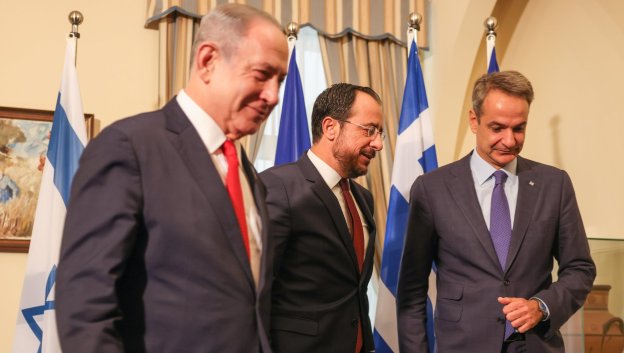
I am pleased to share my latest research, “Revisiting the Foreign Policy of the Republic of Cyprus and Quasi-Alliances in the Eastern Mediterranean,” where I analyze how Cyprus has adapted to geopolitical shifts and positioned itself within evolving regional power structures.

Abstract

The Eastern Mediterranean has emerged as a significant geopolitical region in the 21st century, influenced by both intra-regional dynamics and the strategic interests of international powers. The Republic of Cyprus (RoC)—a small state within this region—has endeavored to adapt to the evolving international landscape and promote its own strategic interests. This paper examines the RoC’s foreign policy in the Eastern Mediterranean, particularly its involvement in regional cooperation and the formation of quasi-alliances. The primary focus is twofold: situating the RoC’s foreign policy within the international-regional nexus (particularly US policy in the Eastern Mediterranean and US–RoC relations) and assessing its strategic objectives and priorities. The analysis revisits the formation of quasi-alliances, such as the Israel–Cyprus–Greece and Egypt–Cyprus–Greece partnerships, and regional networks of cooperation. The key questions addressed include the success of RoC policy since the early 2010s, the positives and negatives of its approach, and the preconditions for a more effective foreign policy. The paper concludes that, despite notable progress, the RoC’s foreign policy suffers from a lack of vision, strategic planning, and institutional capacities, making it vulnerable to domestic politics, populist rhetoric, and geopolitical shifts.

Key Insights from the Paper

🔹 The rise of quasi-alliances – Cyprus has formed strategic partnerships with Israel, Greece, and Egypt, strengthening its regional presence.
🔹 Perceptions of threat vis-a-vis Turkey and the prospect of energy cooperation played a key role in shaping regional quasi-alliances.
🔹 The role of the United States – Over time, Washington has integrated Cyprus into its regional security framework, lifting arms embargoes and expanding cooperation.
🔹 Challenges & limitations – While these partnerships have enhanced Cyprus’ diplomatic reach, they remain informal, lack military commitments, and are often vulnerable to external geopolitical shifts.
🔹 The need for stronger strategic planning – For Cyprus to maintain and expand its influence, it must enhance institutional capacities and develop a more proactive foreign policy vision.

This research contributes to the broader discourse on small state foreign policy, regional security dynamics, and energy geopolitics in the Eastern Mediterranean.

📄 You can read the full paper here

Feel free to reach out with comments or questions.

On Eastern Mediterranean Geopolitics

The eastern Mediterranean has been attracting a lot of attention, especially since the early 2010s, mainly because of the natural resource discoveries and the changing interstate relations. I’ve been following these developments since the beginning with a number of opinion editorials in English and Greek. By 2013 my interest started turning into a small research project. The results were published in different – albeit thematically overlapping – papers over the course of 2015 and early 2016 (see below). Though I thought that the latest article would conclude this project, as I’m now turning my focus towards the “Islamic State”, Turkey and the Middle East, it’s likely that the ongoing rapid developments will lead to more research on this subject. Contact me for more information.

073ed-where_is_cyprus Continue reading

The post-Referendum Greece: Between Challenges and Hope

Source: Reuters

On Sunday, July 5, 2015, the Greek people gave a clear ‘No’ to a proposed bailout deal by the Troika (the European Commission, International Monetary Fund and European Central Bank). Though the national referendum was specifically about the Troika’s proposed plan, both Greek and European leaders and the media transformed it into a vote on Greece’s participation in the Eurozone and ultimately the European Union. The Syriza[1]-led government vocally supported the ‘No’ vote, arguing that the position would provide Greece with the leverage to negotiate a better deal with the creditors. Traditionalist center and right-wing parties supported the ‘Yes’ vote, voicing concerns that a rejection of the Troika deal would lead Greece to default, a return to drachma (Greece’s pre-Euro national currency), an exit from the EU, and eventually international isolation.[2] Continue reading

A Note on Greek Foreign Policy under Syriza

Source: Reuters

Much has been said and written about the foreign policy that will be followed by the newly-elected coalition government in Greece that consists of majority Syriza (Coalition of the Radical Left) and minority center-to-right wing ANEL (Independent Greeks). Much of the fear-mongering and gloom analysis stems from assumptions that Syriza and many of its members (such as new Foreign Minister Dr. Nikos Kotzias) are anti-European, leftist nationalists and pro-Russian. A short evaluation will show that although we might witness some foreign policy alterations due to the rise of Syriza, they will neither be to an “axis-shift” extent nor, for example, akin to the change that we’ve witnessed in Turkey under the Justice and Development Party (AKP).  Continue reading

Syriza’s Victory and Greek-Israeli Relations

Source: GreekReporter

By Zenonas Tziarras* & Ioannis-Sotirios Ioannou**

The Coalition of Radical Left (Syriza) was the big winner of the Greek national elections of January 25, 2015, as expected. With 36.34% of the votes, Syriza and its leader (now Prime Minister) Alexis Tsipras won 149 seats, two seats shy of absolute majority. New Democracy, of now former Prime Minster Antonis Samaras, came second with 27.86% and 76 seats. Syriza chose to form a coalition government with Panos Kammenos’ populist and far-right (though often-referred to as center-right) Independent Greeks (ANEL), that won 13 seats with 4.8% of the votes. Not only that, but Tsipras appointed Kammenos as the new Minister of Defense. Although leftist Nikos Kotzias, Syriza’s new Foreign Minister, is more cool-headed and pragmatist, if assertive, than Kammenos, the Ministry of Defense plays an important role in security issues and Kammenos might adopt a harder line that could challenge Greece’s overall foreign policy with particular respect to relations with Turkey and Israel. Overall, these developments may signal a new approach in Greek foreign policy on issues ranging from the EU, to Russia and the Eastern Mediterranean. Continue reading