Category Archives: Middle East

Countering ISIS: A Special Kind of Insurgency

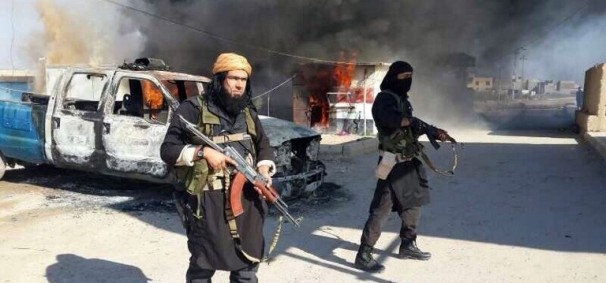
Iraq-ISIS-606x283It is commonplace these days to refer to the Islamic State of Iraq and al-Shām (i.e. Greater Syria) – henceforth, ISIS – as the greatest threat to regional, international, and for some countries, even national security. As a product of mergers between smaller Islamist groups (e.g. an al-Qaeda affiliated Iraqi group) in the aftermath of the 2003 US-led Iraq invasion, this rapidly evolving organization has been empowered in the context of the Syrian civil war, and has surprised the world when it swept into northern and central Iraq early June 2014. It has changed its name into Islamic State (IS) and declared the establishment of an Islamic Caliphate – a state run according to Sharia law – in Syrian and Iraqi territories.

One of the biggest questions that needs to be answered is, how do we counter ISIS? Almost three months after ISIS advanced into Iraq, US President Barak Obama stated, “We don’t have a strategy.” This was quite a surprising statement coming from the White House given the high level of threat that ISIS poses; but it is, nonetheless, true. However, it was later decided for Obama to announce his plan against ISIS in an address to the nation on September 10th. Among other things, Obama is expected to introduce ways of enhancing international cooperation against ISIS and try to display a more coherent and decisive stance than the one presented thus far. Continue reading

Turkey, Kurds and the Islamic State: A Strange Triangle

Among the paradoxes of the Middle East today is Turkey’s relationship with Iraqi Kurds and the “public secret” of its relationship with Islamic State which has seized territories in Syria and Iraq and has announced the de facto establishment of an Islamic Caliphate. How could Turkey’s collaboration with the Kurds – whom it used to see as a threat – be explained, and what does it have to gain from Islamic State?

That Turkey (along with Qatar, Saudi Arabia, and other Western powers) has funded and supported Islamic State (IS) is a fact, though neither Turkey nor Qatar admit it. Is it possible that Turkey uses IS against the Kurdish separatist movement in Iraq, Syria and beyond? Such scenario is not supported by the evidence at hand. If for example Turkey wanted to deter the independence of Iraqi Kurdistan then it would not have ignored provisions of the Iraqi constitution and the central Iraqi government of Baghdad, among others, to sign economic and energy agreements with Kurdish Regional Government. Rather, it would have done the opposite: to try and isolate Kurdistan by cooperating with Baghdad. That would be similar to how Turkey acted when it cooperated with Baghdad in the middle to late 2000s while trying to deal with Kurdish guerillas who found safe haven in Iraqi Kurdistan and other locations on Turkey’s southern borders. Moreover, we should not forget that the emergence of IS accelerated Kurdistan’s process of independence instead of the opposite – both in Iraq and Syria. Continue reading

Turkey is Facing a Highly Uncertain Future

Source: Reuters

The Turkish presidential elections of August 10, 2014, bear great significance for the country’s future as well as for its domestic and foreign policies. This will be the first time that the Turkish people will directly elect the president of the Republic; something which, in conjunction with the constitutional reform process, signifies Turkey’s gradual shift from a parliamentary to a presidential system.

The main candidates are three. The current Prime Minister, Recep Tayyip Erdogan, of Justice and Development Party (AKP); Ekmeleddin Ihsanoglu, who is supported by the two main opposition parties (Republican People’s Party and Nationalist Action Party), as well as by three smaller parties (Democratic Left Party, Independent Turkey Party, and Democratic Party). The third and with less chances candidate is Selahattin Demirtas, the co-president of the main pro-Kurdish party of Turkey, People’s Democratic Party (HDP). Continue reading

The Iraq Crisis and Its Geopolitical Implications

Source: Reuters

On June 10, 2014, the Islamic State of Iraq and al-Sham (i.e. Greater Syria) – henceforth, ISIS – surprised the world by advancing into several territories of central and northern Iraq. Most notably, ISIS has taken over Iraq’s second biggest city, Mosul, and the also important cities of Fallujah and Tikrit (the birthplace of former Iraqi leader, Saddam Hussein). ISIS has also tried to gain control of the oil-rich area of Kirkuk (which is now under the control of Iraqi Kurdish forces). Furthermore, it is said that the vitally important oil refinery in Baiji has been almost completely taken over by ISIS in an offensive against the Iraqi army.

Most importantly, ISIS has declared itself to be an Islamist “Caliphate” (i.e. Islamic state) and has unilaterallydeclared statehood in Syrian and Iraqi territories under its control. The group has recently renamed itself as the “Islamic State” and declared the group’s leader, Abu Bakr Al Baghdadi, as the new caliph of the Islamic State and the leader of Muslims everywhere.

ISIS’offensive has left the Iraqi state in a dire situation, ridden by sectarian and ethnic conflict. The conflict has created a large number of refugees, and has threatened Iraq’s capital, Baghdad. The following addresses the roots and ideological features of the conflict, in addition to the geopolitical implications of the Iraqi crisis for regional relations and U.S. foreign policy. Emphasis is placed upon analyzing the most important developments and their implications rather than on facts, as the situation on the ground is highly fluid. Continue reading

Turkey’s “Multi-Scenario” Foreign Policy

Abstract

Turkish foreign policy has always been a puzzling issue for both Western and non-Western scholars. Yet, the ascendance of the Justice and Development Party (Adalet ve Kalkınma Partisi – AKP) to power in 2002 made things even more complicated as it signified the gradual break of a national ideological tradition and the emergence of a post-Kemalist, neo-Islamist, ideological framework. Despite the various existing explanations, analyses and interpretations of the AKP’s foreign policy, this paper seeks to contribute to this debate by employing a different (multi-scenario) approach. It assumes that the conduct of Turkish foreign policy is based on the existence of probable scenarios, often substitutionary to each other. If that is indeed the case, then Turkish foreign policy is conducted in an opportunistic way which lacks a specific Western or Eastern orientation, and aims at the maximization of benefits in different isolated issues thus diminishing the possibility of having a comprehensive grand strategy. Through this prism it is made clear that every important issue on Turkish foreign policy agenda plays a central role in its indecisiveness and leads de facto to a Multi-Scenario foreign policy.

Click to here to read the full peer-reviewed publication on the Centre for Policy and Research on Turkey.