Category Archives: Turkey

Turkish Foreign Policy and the Leaked Tape on Syria

While presenting my paper on a Neoclassical Realist theorization of Turkish foreign policy, yesterday (28/03/2014), I was “accused” of being wrong that systemic-geopolitical factors and national security considerations were the primary factors that turned Turkey against Syria (from friend to enemy) in late 2011. Some scholars (including Turkish ones) were saying that Turkey’s regional image, model, and legitimization (i.e. to be a promoter of democracy and “on the right side of history”) were more important.

Well, in the leaked tape (attached below) regarding Turkey’s Syria policy, you can see that national security, including the Kurdish (PKK) threat (which was one of my points), is central to Ankara’s decisions with regard to Syria. It is also clear that they have been wanting to do more (i.e. intervene) all along – which is, again, one of the arguments I make in articles and my PhD. However, a number of factors, which I will not mention here, led Turkey to adopt only an indirect involvement (e.g. supporting the rebels and sanctions). As occurs from the tape, they are today regretting the fact that they did not take more drastic measures in the recent past, although they do acknowledge the practical, tactical and logistical difficulties. Continue reading

Book Review: The Arab Spring, Democracy and Security: Domestic and International Ramifications, Efraim Inbar (ed)

book reviewTo offer analysis on an on-going political event is always a challenging task. Yet, the “Arab Spring” has given rise to many questions about the past, the present and the future of the Arab world and the Middle East more generally. The Arab Spring, Democracy and Security: Domestic and International Ramifications addresses some of these questions. The chapters of this edited volume have been written by selected Israeli scholars focusing on “issues such as democratization, the role of economic factors in political change and explanations for variations in regime stability in the Middle East.” The relationship between internal and external politics is also explored while special emphasis is given to the impact of the “Arab Spring” on Israel and its neighbourhood.

Read the rest of this book review in the Journal of Conflict Transformation and Security.

Turkey’s Imbalances and Identity Crisis

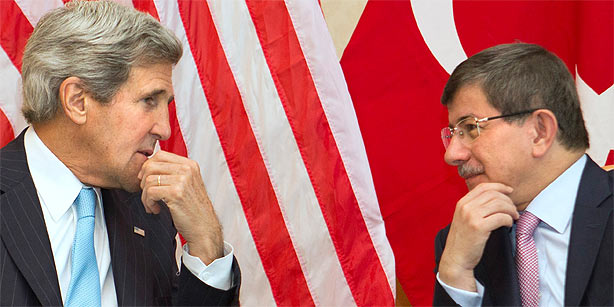
davutoglu-speaks-to-kerry

Source: Reuters

It was June, 2013. I arrived in Ankara, Turkey, right on time to witness the development of the protests that began at Istanbul’s Gezi Park and spread throughout the country’s urban centers, as well as to experience and participate in the social and political discussion that was taking place at that time. The purpose of my visit included the participation in a conference on Turkish foreign policy and some field research. That gave me the opportunity to speak and exchange views with students of International Relations, academics, experts, and diplomats.

A widespread understanding was that Turkish society had been left without a political alternative. In other words, the political opposition – most notably the Republican People’s Party, CHP – was not an adequate opponent to the ruling Justice and Development Party (AKP). And there was no other option. Most of the people I discussed with were open in expressing their discomfort with the AKP’s policies. Others, mostly people affiliated in one way or another to the government, appeared more reluctant to directly criticize the AKP. Yet the consensus was clear: The AKP has made significant improvements with regard to the country’s democratization, economy, and foreign policy. But this did not change the fact that it became gradually authoritarian by having a majoritarian approach to democracy. As often argued, this was also reflected in foreign policy. Continue reading

Where is Erdogan Headed?

It is well known that “power corrupts and absolute power corrupts absolutely.” So here is the question: Given that Turkish Prime Minister, Recep Tayyip Erdogan, does not possess absolute power and yet is considered by many to be corrupt and increasingly authoritarian, where would his pursuit of absolute power lead him and what would that mean for Turkey? In this light, the importance of the current protests in Turkey lies not so much in the political change that they could bring about, but in the possibility that they might not bring about the political change they would like to.

When he first assumed power in 2003, Prime Minister Erdogan entered the political scene with a reformist dynamic. A promising dynamic for Turkey’s economic development and growth, its relations with the EU, its civil-military relations and its democratization process, its abidance with the international and EU law, and the overall political, economic and social stability of the country as well as its increasingly important position in the region and the world. Erdogan, and his Justice and Development Party (AKP), succeeded to a great extent and Turkish people loved him for that. He gave Turkey the impetus that many believed it should have. But this is not the whole story. The more PM Erdogan and the AKP consolidated their power over the state and at the expense of the political power of the military, the more their control became “asphyxiating” (for many) and their policies reflected a top-down conservative social engineering project. Continue reading

A Regular Day in Kızılay Square

After Protesters had Backed Away

Today was Sunday and people had more time to protest here in Ankara, Turkey. Normally protests take place during the night. Kızılay is the name of the main square of Ankara, the battlefield, in essence, where the clashes between the Turkish police and the demonstrators are taking place over the past two weeks or so. But these are not mere protests, this is really a war. At this point it doesn’t really matter who started it; the situation has not gotten out of hand with regard to the protests simply because the police operations are already out of hand. The use of force and intimidation is vastly disproportionate compared to the number of protesters. Continue reading