Category Archives: Middle East

Turkey’s Imbalances and Identity Crisis

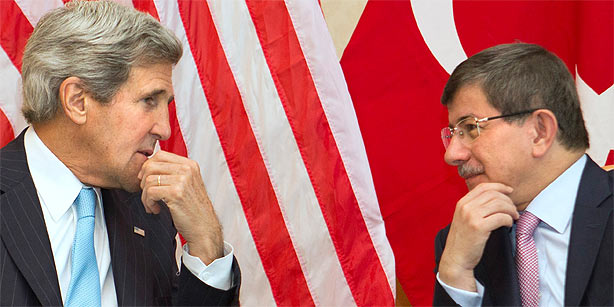
davutoglu-speaks-to-kerry

Source: Reuters

It was June, 2013. I arrived in Ankara, Turkey, right on time to witness the development of the protests that began at Istanbul’s Gezi Park and spread throughout the country’s urban centers, as well as to experience and participate in the social and political discussion that was taking place at that time. The purpose of my visit included the participation in a conference on Turkish foreign policy and some field research. That gave me the opportunity to speak and exchange views with students of International Relations, academics, experts, and diplomats.

A widespread understanding was that Turkish society had been left without a political alternative. In other words, the political opposition – most notably the Republican People’s Party, CHP – was not an adequate opponent to the ruling Justice and Development Party (AKP). And there was no other option. Most of the people I discussed with were open in expressing their discomfort with the AKP’s policies. Others, mostly people affiliated in one way or another to the government, appeared more reluctant to directly criticize the AKP. Yet the consensus was clear: The AKP has made significant improvements with regard to the country’s democratization, economy, and foreign policy. But this did not change the fact that it became gradually authoritarian by having a majoritarian approach to democracy. As often argued, this was also reflected in foreign policy. Continue reading

Egypt Military-Backed Gov’t Takes Decisions that Would Sustain its Own Role – Expert [Interview with Z.T.]

Egypt has lifted its three-month state of emergency on Tuesday. The measure would mean an end to night-time curfews that choked economic life in the country. The court decision comes amid continued protests across the country. Meanwhile, the government edges a step closer to passing a law on demonstrations that the opposition says could be a new way to curb protests. Zenonas Tziarras, Teaching Assistant at the University of Warwick and Junior Research Scholar at the think-tank “Strategy International”, Greece, shared his insight in the situation in Egypt in an interview with the VoR. Continue reading

A Note on the Socio-Political Importance of Events in Egypt

The unfolding events in Egypt, which initially started with the break out of the revolt in 2011, are very important in terms of their social and political impact. Particularly important are not the events themselves, but rather the dynamics and prospects which have been developed through them, both at the domestic and the regional level.

To begin with, it is today clear that the social turmoil of 2011 was not a revolution which brought about systemic changes to Egypt’s political scene, but rather a revolt with limited political and ideological cohesion and goals.[i] Yet, the second, and more massive, revolt of the summer of 2013, which also led to the overthrow of President Mohammed Morsi of the Muslim Brotherhood, is indicator of an important fact: The Egyptian society is currently at a point of rupture of the historical cycle during which it had become de-politicized through imposed top-down policies. It is undergoing a process of re-politicization and it is gradually realizing its rights and power; and thus the refusal of the masses to accept the governance of a Muslim Brotherhood that did not meet their demands. Continue reading

The Thoughtlessness of the Intervention Advocates – Syria (revisited)

Author’s Note: The following article, titled “The Thoughtlessness of the Intervention Advocates – Syria,” was published by Al Yunaniya on June 16th, 2012. It makes the case against an intervention in Syria. Sadly, more than one year later things have remained largely the same in terms of the Western stance and rhetoric vis-à-vis the Syrian crisis. Once again, at a crucial juncture it seems that the “International Community” (admittedly dominated by Western countries) is contemplating an intervention in Syria. Wrongfully, in this author’s opinion, the debate revolves around legalistic, tactic-related, and grand strategy arguments. Even more problematic is the effort to exploit a “moralistic” pretext, such as the use of chemical weapons, to the accomplishment of immoral ends – related to international, economic and geopolitical interests. In this respect the International Crisis Group report was absolutely right to point out that should an intervention is decided, it would be undertaken “for reasons largely divorced from the interests of the Syrian people.” And that is all that matters.

Let us and the international society not fool ourselves: The International Community, NATO, and even individual countries willing to get involved in an intervention in Syria – be it authorized by the UN or not – will comprise a coalition of national and international elites completely dissociated from the intentions and interests of the public opinion and, even worse, dissociated from the interests of the Syrian people. Any effort of political communication by (inter)national leaders in favor of an intervention in Syria advocating that the operations would be “surgical” and that there would be benefits rather than new problems for the Syrians is largely misleading. Continue reading

Where is Erdogan Headed?

It is well known that “power corrupts and absolute power corrupts absolutely.” So here is the question: Given that Turkish Prime Minister, Recep Tayyip Erdogan, does not possess absolute power and yet is considered by many to be corrupt and increasingly authoritarian, where would his pursuit of absolute power lead him and what would that mean for Turkey? In this light, the importance of the current protests in Turkey lies not so much in the political change that they could bring about, but in the possibility that they might not bring about the political change they would like to.

When he first assumed power in 2003, Prime Minister Erdogan entered the political scene with a reformist dynamic. A promising dynamic for Turkey’s economic development and growth, its relations with the EU, its civil-military relations and its democratization process, its abidance with the international and EU law, and the overall political, economic and social stability of the country as well as its increasingly important position in the region and the world. Erdogan, and his Justice and Development Party (AKP), succeeded to a great extent and Turkish people loved him for that. He gave Turkey the impetus that many believed it should have. But this is not the whole story. The more PM Erdogan and the AKP consolidated their power over the state and at the expense of the political power of the military, the more their control became “asphyxiating” (for many) and their policies reflected a top-down conservative social engineering project. Continue reading